

Turning strategy into repeatable, predictable execution.
Most VC-backed healthcare companies at the $2M–$30M stage have proven the product. Early wins are real. The channels are real. The problem isn't the idea — it's that the process that produced the first win was improvised, not designed. And improvised processes don't transfer.
The question every VC-backed company at this stage eventually faces isn't whether the product works. It's whether the company can replicate a win — without the same two people running every play, at a cost structure that doesn't spike CAC and cost-to-serve every time volume increases. The question isn't whether to build the motion. It's whether you build it before the runway shortens the options.
This is not a consulting engagement. We don't deliver a strategy and leave. We install the commercial motion — channel activation, pipeline governance, close discipline, feedback loops — and run it alongside your team until it runs without us. The output is deals moving, forecasts holding, and a team that can execute without the founder in every conversation.
Scalable Revenue
Beyond the hero deal
Board-Ready Forecasts
Projections that hold
Right-Sized Team
No bloated sales org
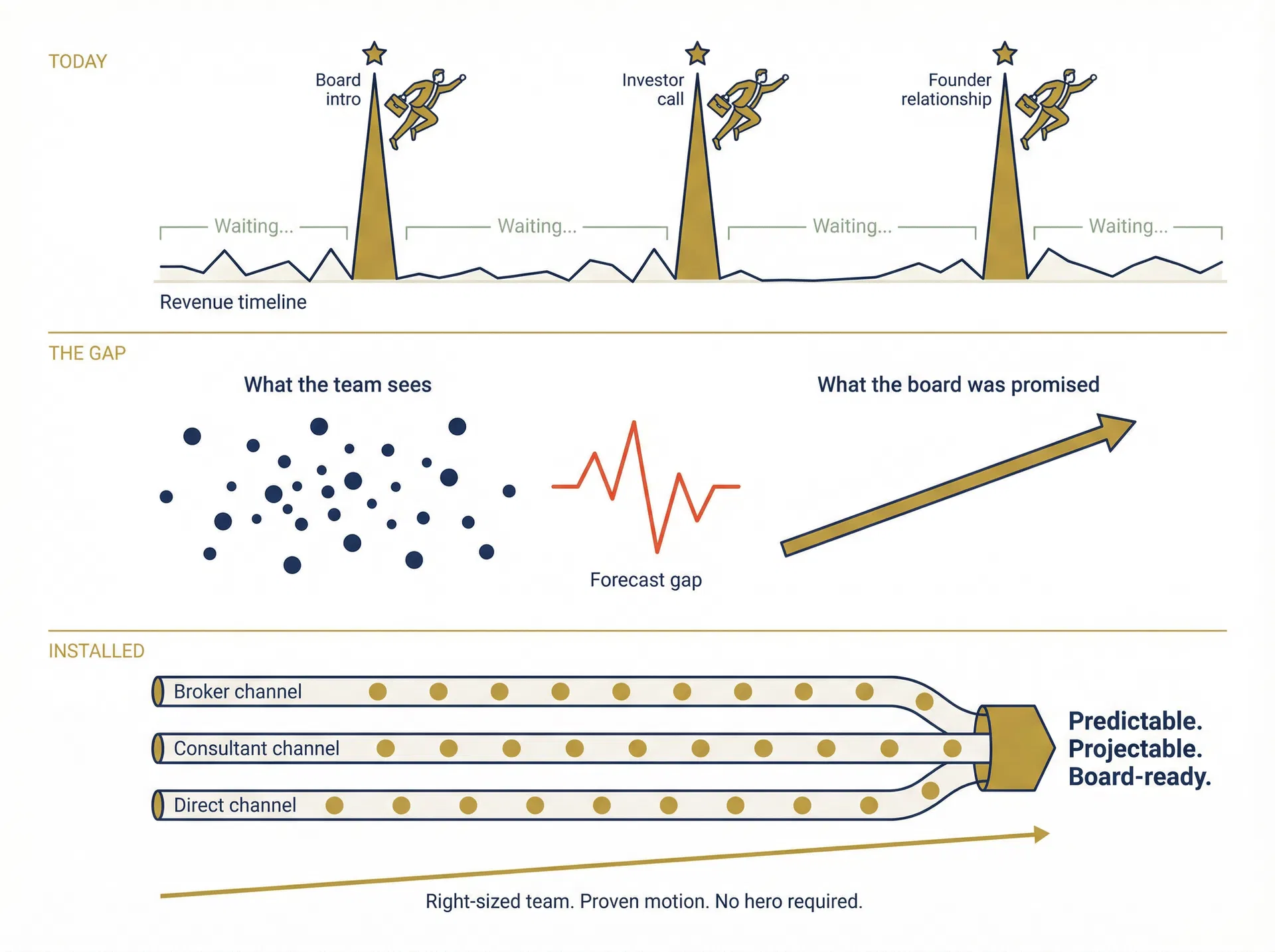
Predictable. Projectable. Board-ready.
No hero required.
Ecosystems I've operated within & build for
Every decision made sense. None of them built the motion.
Across VC-backed healthcare and benefits companies at the $2M–$30M stage, the pattern is consistent. Founders work hard, make intelligent decisions, and build real traction. The gap isn't effort or strategy — it's that no one built the commercial operating foundation the sales team needed to activate.
Brokers and consultants will get it. They just aren't the founder.
Brokers and consultants are sold to constantly. They get it — they just aren't the founder, and they won't treat your product like one. Without a clear offer, a consistent presentation, and a motion that improves from every conversation, you'll frustrate each other and conclude the channel doesn't work. The channel works. The system is missing.
The partner is genuinely excited. That's part of the problem.
The partner is genuinely excited — they see the value, they want your arrow in their quiver, and they'll assign a team to build the business case. The problem isn't bad faith. It's that they overestimate their own demand, underestimate what execution requires, and won't own the sales commitment. The partnership launches underfunded, stalls without traction, or dies quietly. The broker channel that was already working went unscaled while you waited.
The right person. The wrong expectation.
The company hires a senior sales executive from a large carrier or benefits firm. Credible, well-networked, genuinely capable. They close deals in the first two quarters from their personal relationships. The board is encouraged. Then the Rolodex runs dry. The pipeline stalls. Not because the hire was wrong — because no one built the system they were supposed to run. The hero deal pattern didn't go away. It just moved from the founder to the sales hire.
The Exit
The channels were never the problem. The system was.
The commercial motion isn't something a sales leader builds — it's something they activate. But only when the foundation exists for them to run. Most companies skip that step. They hire before they build. The process that produced the first win was improvised, not designed. Improvised processes don't transfer.
Four operating capabilities. Built to transfer, not to present.
Most companies at this stage have proven the product. What they haven't built is the infrastructure to replicate a win — without the founder in every conversation, without cost-to-acquire spiking every time volume increases.
Win Architecture & Replication
You won. Now understand why — and make it repeatable. Who responds to the RFP. Who approves contract terms. Who owns implementation. What it takes to make the next client referencable. The motion has to run without the founder before it can scale.
Message, GTM & Channel Activation
The message has to match what the process can deliver. The GTM has to reach buyers who look like the ones you've already won. And the channel — broker, consultant, TPA, benefits admin platform — has to be activated with the infrastructure in place to handle what comes out of it. Awareness first. Confidence next. Volume follows.
Pipeline Mechanics & Governance
Stage definitions, conversion benchmarks, follow-up discipline, approval authorities. The governance structure that turns a prospect list into a forecast the board can hold the team accountable to — without the founder in every conversation.
Feedback Discipline & Replication
Every deal that closes or doesn't is a signal. The governance captures it, interprets it, and acts on it. Repeat what works. Adjust what's marginal. Stop what doesn't. This is what keeps cost-to-acquire and cost-to-serve from scaling linearly with growth.
The Pattern
The output is the motion — running.
Channels activated. Pipeline governed. Deals moving on your terms. Forecasts the board can hold the team to. A team that can run the plays without the founder in every conversation.
That's the output. Not a strategy deck. Not a framework to implement later. We run the motion alongside your team until it runs without us — and the cost structure stays right-sized as volume increases.
Ecosystems I've operated within & build for.
Intermediary-heavy distribution is where most healthcare and benefits companies stall. It's where Ritz Healthcare Advisors specializes.
Large and mid-market broker ecosystems where consultants drive plan selection, vendor evaluation, and renewal decisions.
Technology platforms and partner ecosystems where distribution flows through enrollment, administration, and HR tech channels.
Administrator-led channels where third-party administrators and professional employer organizations control downstream access.
Examples listed to describe channel structure; not a claim of formal partnerships.
If your product reaches buyers through any of these channels, the intermediary relationship is your primary growth lever — and most companies are leaving it almost entirely unworked.
We build the commercial motions that create predictable deal flow, reduce time to yes, and generate the forecasting discipline your board needs to hold the team accountable — without the founder in every conversation.
Built for a specific kind of company.
Ritz Healthcare Advisors works with a small number of companies at a time. The fit criteria below are intentional — not marketing.
Good Fit
VC/PE-backed healthcare or benefits business, $2M–$30M revenue
Founder, board, or 1–2 rainmakers are still the conversion engine
Distribution is intermediary-heavy (consultants, brokers, platform partners)
Leadership wants predictability and forecasting — not just activity
Growth is real but not yet repeatable or scalable beyond the hero
Not a Fit
Looking for a strategy engagement with defined deliverables and an end date
Expecting a report, a framework, or a deck to hand to the team
Pre-revenue or pre-product — no commercial motion to build from
PE-backed with a large internal commercial or consulting infrastructure already in place
Founder who wants to remain the sole commercial engine and isn't ready to change that
If the fit criteria resonate, the next step is a short conversation.

End-to-End Operator
20+ years as President and P&L owner at Humana and BCBS — accountable for the full business, not just a function.
Repeatable Growth Architect
Market, regional, and enterprise sales, product, and marketing leadership — built distribution engines that scale beyond the founder.
Affordability Engine
Direct accountability for provider contracting, trend management, utilization, P&L, and admin — the levers that determine margin and sustainability.
Charles L. Ritz
Operator & Advisor · Go-to-Market + Execution Cadence · Predictable Growth & Forecasting
Charles Ritz is an operator and advisor who helps founder-led and PE-backed companies scale beyond founder-led sales by installing commercial operating discipline: channel governance, pipeline mechanics, forecasting reliability, stall prevention, and leadership cadence with board-ready reporting.
Across his executive career, Charles was repeatedly pulled into complex, high-stakes situations where the opportunity was real but performance was inconsistent. A defining pattern in his work has been translating strategy into execution — clear actions, owners, operating cadence, and measurable accountability — so results become predictable rather than heroic. He is known for simplifying complexity into a small set of priorities and building the operating model that connects day-to-day decisions to plan outcomes.
His strategic-to-operational lens consistently organizes work around five themes leadership teams care about most: growth, consumer experience, culture, profitability, and operational effectiveness. Today, through Ritz Healthcare Advisors, Charles supports leadership teams and boards as an operator-level partner — methodology-agnostic and explicitly not rep sales training — focused on systems leaders can run and sustain.
Commercial Predictability
Converts founder- and board-led "hero deals" into a repeatable growth engine — channels activated, pipeline governed, close discipline installed, and forecast confidence earned through the work, not the deck.
Provider Economics & Affordability
Deep experience aligning contracting, trend management, and value-based care execution to drive affordability and quality outcomes without sacrificing growth.
Partnership & Distribution Strategy
Fluent in the broker, consultant, employer, health plan, and provider ecosystem — accelerates partnerships and improves conversion by matching offer design to buyer reality.
Engaged Governance
Coaches leaders, raises decision hygiene, and installs the operating cadence that makes results board-predictable. Willing to be hands-on where impact warrants — not just advisory.
Board & Advisory Candidate
Available as a board or advisory candidate for VC/PE-backed healthcare and benefits companies where growth is real but not yet reliable. Distribution, commercial predictability, and board-ready forecasting are the value-creation agenda. Operator-level. Hands-on where impact warrants.
Beyond the core practice, the work finds me.
If your situation doesn't fit neatly into a category, that's often where the most interesting work begins.
Compound Medicine Channels
Pharmacy Distribution
Go-to-market and distribution strategy for compound pharmacy operators navigating specialty channel complexity, intermediary relationships, and compliance-aware growth.
Healthcare Intelligence & Automation
AI-Powered Utilization Management
Advisory for companies deploying AI to improve utilization review, prior authorization, and clinical decision support — with a focus on payer and provider adoption dynamics.
Direct & Employer-Sponsored Models
Mobile Primary Care
Market entry, employer channel strategy, and distribution design for mobile and virtual primary care platforms seeking to scale through intermediary and direct employer channels.
These engagements share a common thread: complex distribution, intermediary ecosystems, and growth that requires both operator instinct and strategic clarity. If that sounds like your situation, let's talk.